


Even OpenAI Is Pointing to Optical Computing. We've Already Built It.


What Did Sam Altman Say About Optical Computing?
In a recent interview on the Invest Like the Best podcast, the OpenAI CEO called the computers running today's AI fundamentally the wrong machines, a roughly 50-year-old paradigm built for a world of desktop calculators. OpenAI's near-term answer is custom silicon, but looking further out Altman pointed to optical computing, using light instead of electricity, as the path to radical gains in intelligence per watt. Lumai has been building exactly that since 2021: its Iris servers cut inference energy roughly 10x versus GPUs and deploy today in existing air-cooled data center racks.
***
Sam Altman doesn't say much about hardware. When he does, it's worth reading closely.
In a recent, wide-ranging interview on the Invest Like the Best podcast, the OpenAI CEO made a striking admission: the computers running today's AI are, in his words, fundamentally the wrong machines. The paradigm is roughly 50 years old, built for a world of desktop calculators awaiting the occasional human command. What AI needs now, he argued, is something else entirely, and that means rethinking computing from the silicon up.
OpenAI's near-term answer is custom silicon: a chip called Jalapeño, purpose-built for specific AI workloads. But Altman didn't stop there. Looking further out, he pointed to optical computing, using light instead of electricity to run the underlying math, as the path to radical gains in intelligence-per-watt.
We agree. We've just been building it since 2021.
The constraint is energy.
Frontier AI labs are projecting roughly a 1,000x increase in the effective compute needed over the next five years. Delivered with conventional digital accelerators, that's on the order of $100 trillion in infrastructure and 1,000 GW of additional electrical capacity, more power than most countries generate today. That isn't a scaling problem. It's a physics problem, and it's why the industry's most resourced player is now openly saying incremental silicon improvements are finite, and a fundamentally different compute technology is required.
That's not a hypothetical for us, it's the founding premise of Lumai.
Intelligence-per-watt is the metric that matters now.
For years, AI infrastructure conversations centered on raw throughput: more FLOPS, bigger clusters, faster interconnects. Altman's comment reflects a shift already underway inside the labs that will define the next phase of the industry. The question isn't just how much compute you can build. It's how much intelligence you can extract per unit of energy, because energy, not chip design, is now the binding constraint on how far AI can scale.
That reframing matters because it's exactly the problem optical compute is built to solve. Matrix multiplication, the dominant computation in AI inference, doesn't require electrons switching through transistors, it can be performed with light. And because optical systems scale compute quadratically with matrix size while energy grows at most linearly, the efficiency gap between optical and electronic compute only widens as models get larger, which is precisely the direction the industry is headed.
Where Lumai already is.
Here's the difference between a prediction and a product. Altman describes optical computing as something "further out." Lumai Iris is deployable today.
Spun out of world-leading optics research at the University of Oxford in 2021, Lumai builds fully integrated optical AI accelerators that perform real-time, end-to-end inference of billion-parameter LLMs in data centers, using light rather than electricity to execute the matrix multiplications that dominate inference workloads. Our first generation, Iris Nova, is built and validated on billion-parameter LLM, achieving roughly a 10x reduction in energy per inference compared to GPU-based equivalents, and it's ready for evaluation now. It drops into existing air-cooled data center racks, with no liquid cooling, no exotic materials, and no new construction required. Components are derived from the same high-volume technology already used at scale in data center communications, not speculative lab hardware.
This is purpose-built for prefill, the compute-intensive, matrix-heavy phase of disaggregated inference, freeing conventional GPU hardware to handle the memory-bound decode workloads it's actually suited for. It's a complement to existing infrastructure, not a rip-and-replace bet.
The frontier is converging. We got here first.
There's something worth sitting with when the CEO of the company defining the current AI moment describes your core technology as the next frontier. It's not validation we needed, the physics were never in question, but it is a signal that the rest of the industry is also recognizing the need to change the way that AI is computed.
The $100 trillion, 1,000 GW problem isn't solved by building more of the same, faster. It's solved by a different substrate for computation altogether. Optical compute isn't a moonshot anymore. It's a deployable answer to the question frontier AI Lab CEOs are only now starting to ask out loud.
Sources: Altman's comments referenced above are from his interview on the Invest Like the Best podcast, as reported by BigGo Finance, July 28, 2026.
Frequently Asked Questions
What is intelligence per watt and why does it matter now?
For years, AI infrastructure conversations centered on raw throughput: more FLOPS, bigger clusters, faster interconnects. The question now is how much intelligence you can extract per unit of energy, because energy, not chip design, is the binding constraint on how far AI can scale.
Why does optical compute get more efficient as models grow?
Matrix multiplication, the dominant computation in AI inference, does not require electrons switching through transistors; it can be performed with light. Optical systems scale compute quadratically with matrix size while energy grows at most linearly, so the efficiency gap over electronic compute only widens as models get larger, precisely the direction the industry is headed.
How is Lumai different from the optical future Altman describes?
Altman describes optical computing as further out. Lumai Iris is deployable today: spun out of Oxford optics research in 2021, Iris Nova is built and validated on billion-parameter LLMs, achieves roughly a 10x reduction in energy per inference compared to GPU-based equivalents, and drops into existing air-cooled data center racks with no liquid cooling, no exotic materials, and no new construction required.
Iris Nova is available for evaluation today. Contact Lumai to arrange one.
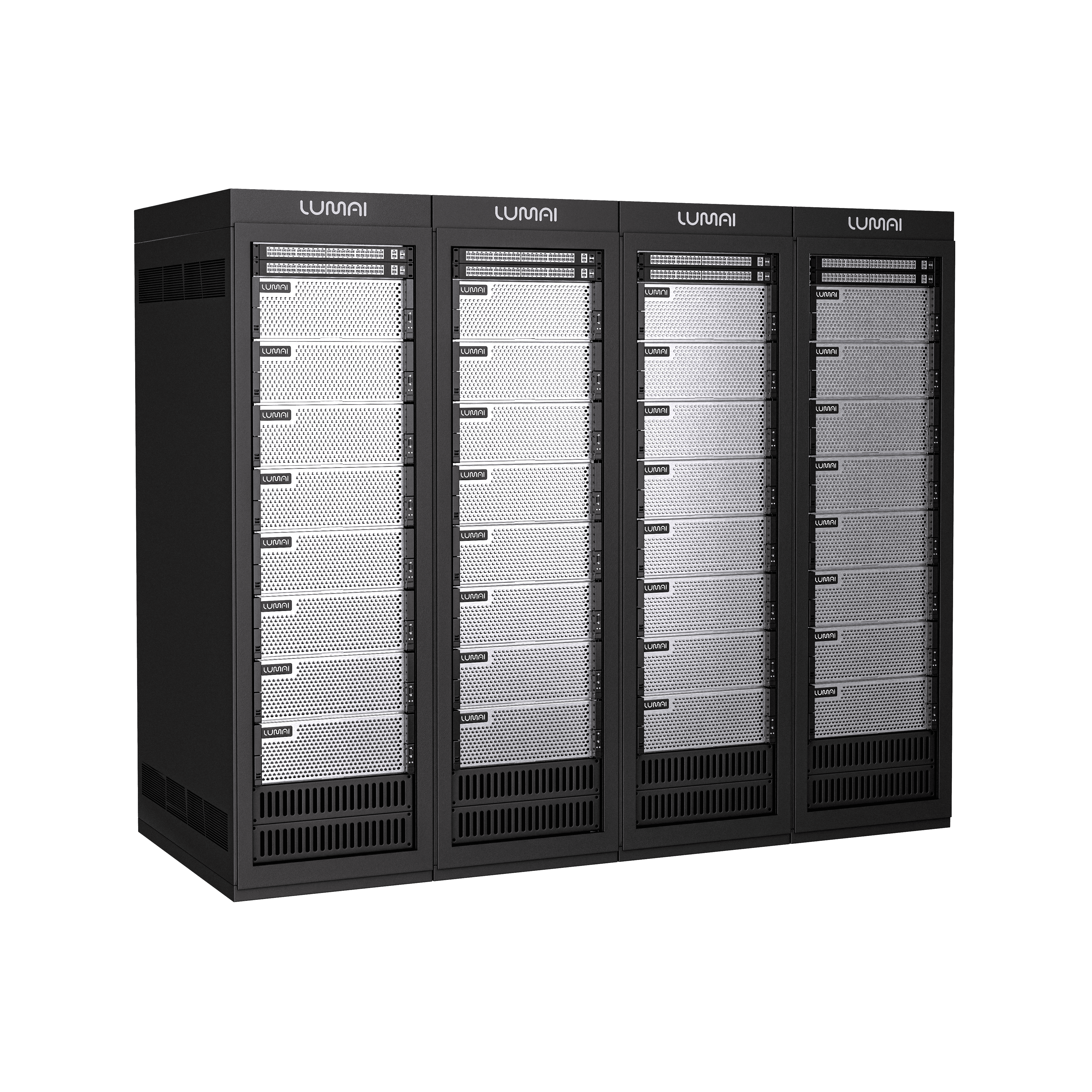
A first for optical compute: running billion-parameter LLMs in real time
.jpg)
Light Over Silicon: Why Optical Compute Is AI Infrastructure's Next Chapter
.png)
