Light Always Wins: How Optics Is Completing Its Journey Into the Heart of AI


How Did Optics Move From Telecoms Into AI Compute?
A pattern repeats through computing history: a new technology proves itself in one application, then moves closer to the core as existing approaches hit their limits. Optics proved itself first at distance, and by the mid-1990s global telecommunications ran on glass. The same economics then became compelling for shorter spans: metropolitan networks, campus networks, then inside the data centre itself as cloud infrastructure spread computation across thousands of servers. The destination is the compute engine, where Lumai Iris now performs matrix multiplication with light at 10x lower energy.
There is a pattern that repeats throughout the history of computing. A new technology arrives, proves itself in one application and then, as new demands increase and the limitations of existing approaches start to bite, it moves closer. First, to the edge of the problem. Then to the core of it.
Optics is doing exactly this. And understanding where it has been tells you where it is going.
The First Wave: Long Distance
Optics proved itself first at distance, where its advantages over copper were so overwhelming: higher bandwidth, negligible signal degradation over long spans, immunity to electromagnetic interference. By the mid-1990s the global telecommunications infrastructure was built on glass.
The more interesting question is what happened next.
The Second Wave: Into the Data Centre
The economics that made fibre compelling for long-distance communication gradually became compelling for shorter spans. Metropolitan networks followed, then campus networks, and then inside the data centre itself.
This shift coincided with a fundamental change in how computing was structured. The rise of cloud infrastructure meant that computation was no longer monolithic; it was distributed across thousands of servers that needed to talk to each other at extraordinary speed and volume. Copper could handle short hops, but as data centre fabrics scaled, the bandwidth-distance product of copper interconnects started to constrain what was architecturally possible.
Pluggable optical transceivers solved this. The same underlying photonics that had crossed oceans now crossed data centre floors. The components shrank, the volumes exploded, and the economics followed: high-volume manufacturing of optical transceivers drove costs to the point where optics became the default choice for data centre interconnect above certain distances and speeds.
The lesson of this era is important: optical technology did not wait to be invented. It waited to be needed.
The Third Wave: Rack to Rack, Server to Server
We are currently living through optics’ third major migration: from the data centre fabric into the compute cluster itself.
Modern AI training and inference clusters connect hundreds of thousands of processors. The communication patterns between them are on the critical path.
As a result, the interconnect between servers has become a primary engineering concern. Co-packaged optics are now moving those links between servers, between racks, and eventually to the switchfabric itself. The goal is to make the cluster behave more like a single large machine: low latency, high bandwidth, and topologically flexible.
The Fourth Wave: Inside the Compute Engine
Here is where the pattern leads, and where Lumai is building.
The dominant operation in AI inference is matrix multiplication. Every token generated by a large language model passes through an enormous amount of matrix operations: weight matrices multiplied by activation vectors, layer after layer, across billions of parameters.
Traditionally, this has been done in silicon, but the power and thermal costs of switching billions of transistors mean these AI chips have hit power and thermal limits. As we place more compute demands on them, the thermal load compounds. It is not a problem that more advanced silicon process nodes will solve. It is a property of the underlying physics.
Light does not have this problem. An optical system can perform millions of matrix multiplications in a single optical cycle, the time it takes photons to traverse the optical path. It does not charge capacitors. It does not generate heat proportional to the matrix size. It scales differently: as a Lumai optical matrix engine grows, compute increases quadratically while energy grows at most linearly. That relationship does not exist in silicon.
This is not a theoretical claim. Lumai Iris servers, built and validated on Llama 3-scale billion-parameter models, perform real-time end-to-end LLM inference using light to execute the matrix multiplications that dominate the workload. They run in existing air-cooled data centre racks and deliver approximately 10× reduction in energy per inference versus silicon-based equivalents. And it is built using components derived from the same high-volume optical communications technology that has underpinned data centre networking for years.
Why Now
Frontier AI companies project a roughly 1,000× increase in effective compute over the next five years. Delivering that with conventional digital accelerators would require approximately $100 trillion in infrastructure investment and roughly 1,000 GW of additional electrical capacity. Neither number is achievable. The constraint is not transistor density; Moore’s Law has slowed, and its remaining gains are incremental and expensive. The constraint is energy. Silicon has a ceiling, and we are approaching it.
Optics removes the constraint. Not by being a faster version of what exists, but by being a different thing entirely. Optics can compute far more quickly and efficiently than silicon. The Lumai Iris architecture comprises a digital subsystem for non-matrix operations, an optoelectronics layer for signal conversion, and an Optical Tensor Engine that performs matrix multiplication in light. Lumai Iris was built to be used within existing AI infrastructure, using established supply chains and ecosystem which minimizes the friction often associated with bringing in new technology.
The Pattern Completes
Optics spent its first decades proving itself at distance, where its advantages were so overwhelming that the difficulty of deployment did not matter. Then distance shortened, manufacturing matured, and optical interconnects moved inside the building. Then inside the cluster. Now inside the compute system itself.
At each step, the technology moved because the workloads demanded it. At each step, a new set of constraints (copper’s bandwidth limits, silicon’s energy walls) created a gap that optics was uniquely positioned to fill.
The workload is clear. The dominant operation is matrix multiplication. The energy constraint is real and acute. And the same technology that built the internet’s physical layer, refined over forty years into reliable, manufacturable, scalable photonics, is now ready to run at the centre of intelligence itself.
Light always finds a way to get closer to the problem. That is where we are building.
Lumai Iris Nova, the world’s first full optical AI server for billion-parameter LLM inference, is available for evaluation today.
Frequently Asked Questions
What were the first two waves of optics?
Optics proved itself first at long distance, where its advantages over copper were overwhelming: higher bandwidth, negligible degradation over long spans, immunity to interference. By the mid-1990s global telecommunications ran on glass. The same economics then became compelling at shorter spans, and pluggable optical transceivers carried the photonics that had crossed oceans across data centre floors.
What is the third wave?
The migration from the data centre fabric into the compute cluster itself. Modern AI clusters connect hundreds of thousands of processors whose communication patterns sit on the critical path, and co-packaged optics are moving those links between servers, between racks, and eventually to the switch fabric, so the cluster behaves more like a single large machine.
What is the fourth wave?
Inside the compute engine. The dominant operation in AI inference is matrix multiplication, traditionally done in silicon, but the power and thermal costs of switching billions of transistors have hit limits that more advanced process nodes will not solve. It is a property of the underlying physics. Light does not have this problem, and that is where Lumai is building.
Iris Nova is available for evaluation today.Contact Lumai to arrange one.
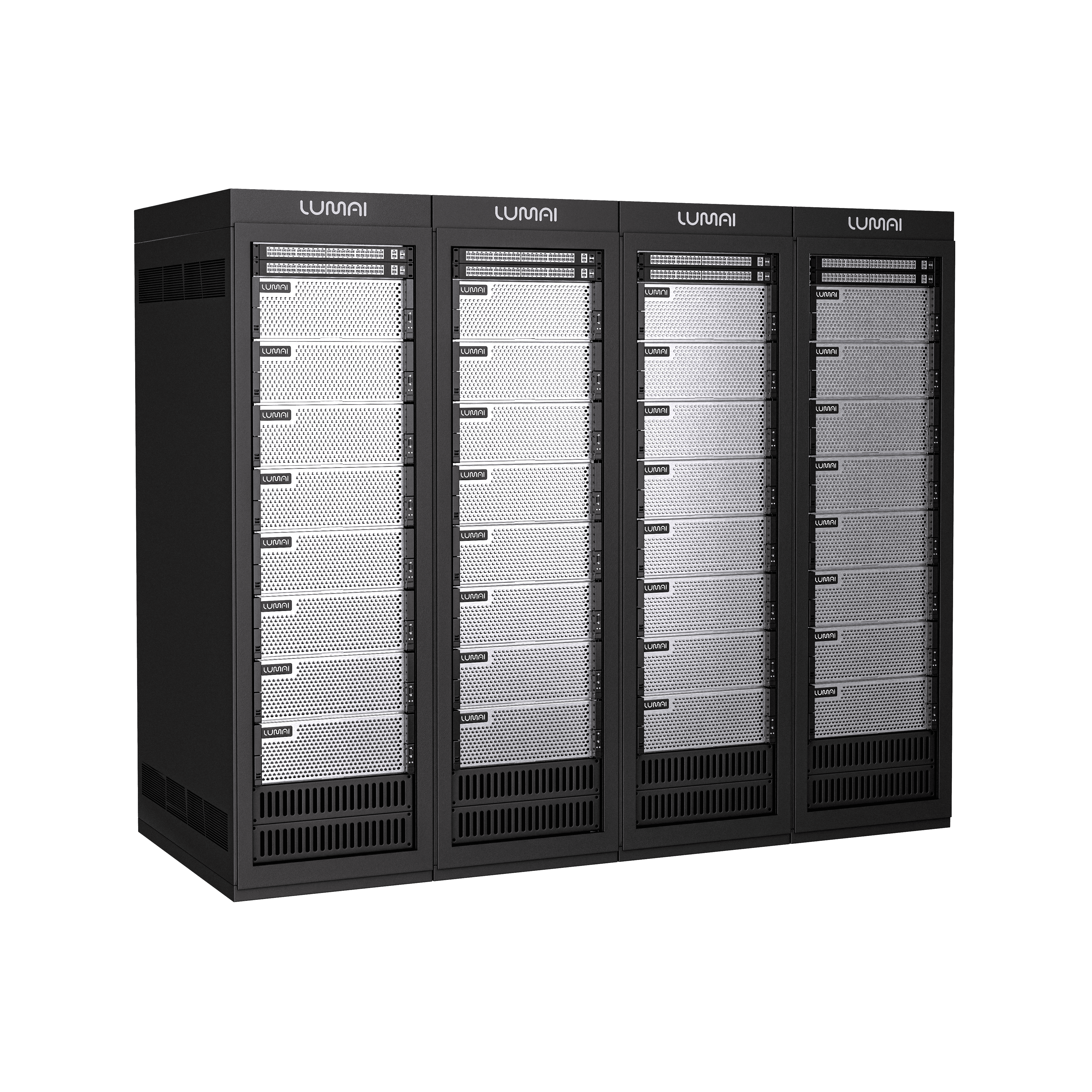
A first for optical compute: running billion-parameter LLMs in real time